
The habits the eye organizations actually publish
The Academy’s starting point is specific: hours at a screen do not permanently damage the eyes, but they do make them uncomfortable, mostly because we stop blinking — about 15 blinks a minute normally, roughly 5 to 7 during screen use in the studies it cites. Every habit below is mechanical rather than medicinal.[3][4]
The 20-minute cue, with the fine print
The institute and the Academy give the same cue: every 20 minutes, look at something at least 20 feet away for about 20 seconds.[1][5] The numbers are a memory aid, not a measured dose. A 2023 study had 30 young adults read from a tablet for 40 minutes with 20-second breaks every 5, 10 or 20 minutes, or none at all; symptoms rose in every session and the schedule made no significant difference.[10] A 2025 study of 24 young adults found that no breaks at all produced more irritation and strain than three breaks or self-timed ones.[11] Breaks from close work help, frequent or self-paced breaks look best, and “20-20-20” is simply the easiest version to remember.
Distance, brightness and blue light
Sit about 25 inches from the screen, roughly arm’s length, looking slightly downward at it. Match brightness to the room, raise the contrast, put a matte filter on a glossy screen, keep artificial tears nearby, and wear glasses rather than contact lenses for long sessions.[3][4] On blue light the Academy is blunt: there is no scientific evidence that blue light from digital devices damages the eye, and it does not recommend blue-light-blocking eyewear for computer use, since studies suggest those glasses do not improve digital eye strain. Its one blue-light habit is for the evening: limit screens in the last hours before bed and use a device’s night setting, because bright evening light makes falling asleep harder.[4][5]
Outdoor light, and the one sunglasses wording that matters
“Time outside is good for the eyes” is usually quoted from research in children: a 2024 Cochrane review of five randomized trials in 10,733 schoolchildren found that programs to increase outdoor time may reduce the development of nearsightedness, with small effects and low-to-moderate-certainty evidence.[12] No equivalent adult trial exists; for adults, a daily walk is distance viewing by default, and the institute lists staying physically active among its basic eye habits.[1] Sun protection has a clear rule. The institute says sunglasses should block 99 to 100 percent of both UVA and UVB, worn even on cloudy days.[1] The Academy puts it in label language — “100% UV” or “UV400” — and adds a broad-brimmed hat, a reminder that clouds do not block UV, and a warning never to look directly at the sun.[6]
The appointment no habit replaces
The institute calls a dilated eye exam the best thing you can do for your eye health: many eye problems have no early symptoms, and dilation is the only way to check for them while they are easiest to manage. Its schedule is every one to two years over 60, earlier for some higher-risk groups and for anyone with a family history of certain eye conditions.[2] The Academy adds a baseline screening by 40 and an exam every year or two from 65.[7][8] A full exam covers acuity, your prescription, side vision, eye movement, pupil response and the pressure inside the eye, a slit-lamp look at the front of the eye, and dilation so the doctor can see the lens, retina and optic nerve.[2][7]
Lutein and zeaxanthin: the honest version
Lutein and zeaxanthin are two yellow plant pigments the body cannot make and deposits in the retina and lens, concentrated in the small central area that handles sharp straight-ahead vision, where they may act as antioxidants and absorb high-energy blue light.[14] Kale and spinach are the richest common food sources, and a typical American diet supplies only about 1 to 3 milligrams of the pair a day.[21]
In a healthy adult, a capsule measurably raises the density of that pigment: a 2016 meta-analysis of 20 randomized trials, 826 of the participants healthy, found a dose-related increase.[16] Whether that changes everyday seeing is less settled. A one-year placebo-controlled trial in 120 healthy drivers taking 20 mg of lutein a day found better contrast and glare sensitivity, especially in dim light, and no significant change in acuity.[17] A six-month trial in 48 healthy young adults with heavy screen time, on 24 mg a day of three carotenoids, reported better contrast, glare and bright-light recovery measures, along with better eye-strain and sleep questionnaire scores, than placebo; it was small, and its lead author consults for the study’s funding sponsor.[18]
Then there is AREDS2, the trial every eye-supplement ad gestures at. The institute enrolled 4,203 adults aged 50 to 85, every one of whom already had a diagnosed, intermediate-to-advanced age-related condition of the central retina, and tested 10 mg of lutein plus 2 mg of zeaxanthin added to a high-dose vitamin-and-mineral formula. People without the condition were excluded on purpose, because the earlier AREDS trial had shown no benefit for them, and the institute’s FAQ says plainly that there was no benefit for people who do not have it.[13][14][15] So this page cites AREDS2 for two things only: the amounts, and safety — the institute notes that lutein and zeaxanthin have not been linked to the cancer concern that got beta-carotene dropped from the formula.[14] No official upper limit exists; a 2006 risk assessment by authors at a supplement-industry trade group set an “observed safe level” of 20 mg a day for lutein, adding that higher intakes may be safe but lack enough long-term data.[19]
The fair summary is narrow. A lutein and zeaxanthin supplement raises a measurable pigment and, in two modest trials, nudged contrast and glare performance. No trial shows it bringing back vision already lost or removing the need for glasses; the Academy says the same of carrots and eye exercises.[9]
The viral sales pages, as they looked on October 7, 2026
We fetched three “official” sales pages for two products in this category ourselves. We are not naming or linking them; the pattern is the point.[28] Each leaned on urgency language: “limited-time special pricing,” “only for today,” “while stocks last.” Two sold a bottle ladder ending at six bottles for $294, starting at $69 for one bottle on one page and $158 for two bottles on the other, each plus $9.99 shipping, against a struck-through “regular” price of $149 or $179 a bottle. Each page promised to “restore” or “regenerate” the retina, one of them “even in advanced stages.” Two of the pages ran a heading claiming the agency’s approval directly above a sentence saying only that the product is made in an FDA-registered facility; a registration is a paperwork filing, not a review of the formula. One headlined a 180-day money-back guarantee and then, in its own FAQ, promised a 60-day guarantee for a product with a different name than the one on the page. One showed five stars from “41,628 reviews” with no review platform attached. Every footer read “Copyright” plus the product or domain name, with no company name or address we could find, and two of the three linked to unrelated supplement storefronts. The ingredient lists were a standard eye blend — vitamin A, zinc, bilberry, lutein, zeaxanthin, astaxanthin, eyebright, omega-3s — with not one amount disclosed.
The videos that feed those pages are well documented. In January 2024, a science fact-checking outlet reviewed social-media ads pitching glasses-free sharp sight through a “7-second bedtime ritual”: the self-described eye specialist in the video could not be identified, the page running the ads had been created only weeks earlier, and two ingredients the ads touted were not on the product’s label.[22] In August 2026, a consumer-security site found the “red root hack” label attached to several different vision supplements built on ordinary lutein, zeaxanthin, zinc and vitamin A, promoted with fabricated doctors, deepfaked likenesses of well-known public figures and imitation news-network branding.[23] In June 2026, a trade publication for eye-care professionals reported that a practicing eye surgeon’s face and voice had been recreated with AI from her clinic’s educational videos and run in paid social ads aimed at older patients.[24] None of the real people whose likenesses appear in such videos made, sold or backed anything.
None of this is new. In 2005 the Federal Trade Commission settled with a retailer whose radio ads said an eye supplement could bring back sight already lost to an age-related retinal condition, and that a study showed 83 percent of ophthalmologists recommended it. The agency charged that the vision claims were unsubstantiated and the statistic false, and the settlement required the company and its owner to pay $450,000.[25] The commission’s current guidance sets the bar at “competent and reliable scientific evidence” — studies conducted and evaluated objectively by experts in the relevant field — and adds that a “results not typical” disclaimer does not rescue a testimonial promising what buyers cannot generally expect.[26]
If you still want a defined daily amount, the plainly labeled option
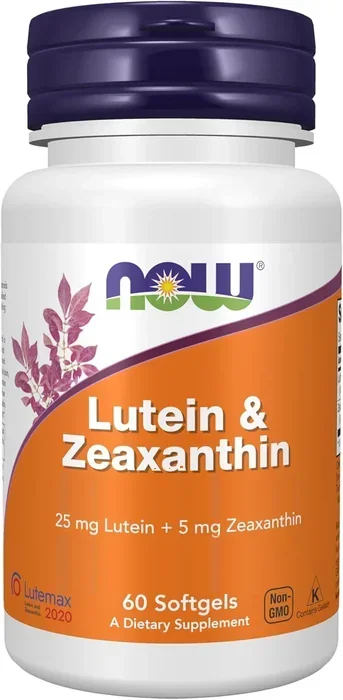
After the habits and an exam, some readers still want the two carotenoids in a set daily amount, worth asking an eye doctor about. The bottle we would point to is NOW Supplements Lutein & Zeaxanthin: 25 mg lutein and 5 mg zeaxanthin per softgel (the Lutemax 2020 marigold extract) in sunflower oil and a bovine-gelatin shell, one a day with a fat-containing meal (worth following: in a controlled study of lutein esters, a related form, blood lutein rose more than twice as much when taken with a 36-gram-fat meal as with a 3-gram one).[20][27] The label is for adults only and sends anyone pregnant, nursing, on medication or managing a medical condition to a physician first. Two cautions: 25 mg is above the 20 mg benchmark, so count any lutein in a multivitamin, and NOW also sells lower-dose lutein products, such as a 10 mg lutein softgel, not reviewed here. This is not the AREDS2 formula, and it is not a substitute for the exam.
On October 7 and 8, 2026, the 120-softgel bottle (ASIN B0DVNG2VDC) showed $26.00, in stock, shipped and sold by Amazon.com — about 22 cents a day. The 60-count listing had no Amazon-sold offer (on October 8 it showed no featured offer at all), so we link the 120-count. The 120-count was marked non-returnable as an ingestible product, except for items that arrive damaged or defective.[27]
See it on Amazon →Plain link: amazon.com/dp/B0DVNG2VDC. As an Amazon Associate, Mind Vitality News earns from qualifying purchases. Price, stock and seller change; check the listing before ordering.
Where this came from
- National Eye Institute (NIH). Keep Your Eyes Healthy: diet, activity, sunglasses blocking 99–100% UVA/UVB, protective eyewear, the 20-20-20 rest cue, dilated exams. Updated Sep 11, 2025. nei.nih.gov
- National Eye Institute (NIH). Get a Dilated Eye Exam: why, how often, what the exam includes, what to expect afterward. Updated Nov 26, 2025. nei.nih.gov
- American Academy of Ophthalmology. Computers, Digital Devices, and Eye Strain: blink rate, 25-inch viewing distance, brightness, glare, artificial tears, contact lenses. Published Jun 27, 2024. aao.org
- American Academy of Ophthalmology. Digital Devices and Your Eyes: screens do not damage eyes permanently, blue-light glasses, evening screen use. Published Dec 5, 2025. aao.org
- American Academy of Ophthalmology. Should You Be Worried About Blue Light? Published Mar 10, 2021. aao.org
- American Academy of Ophthalmology. The Sun, UV Light and Your Eyes: 100% UV / UV400 lenses, hats, clouds, time of day, reflection, never look at the sun. Reviewed Jul 20, 2026. aao.org
- American Academy of Ophthalmology. Eye Exam and Vision Testing Basics: schedule by age and what a comprehensive exam includes. Published Feb 14, 2024. aao.org
- American Academy of Ophthalmology. Get an Eye Disease Screening by Age 40. Published Apr 30, 2026. aao.org
- American Academy of Ophthalmology. Common Eye and Vision Myths: carrots, eye exercises, dim light, glasses. Published Apr 23, 2026. aao.org
- Johnson S, Rosenfield M. 20-20-20 Rule: Are These Numbers Justified? Optometry and Vision Science, 2023;100(1):52–56. PMID 36473088. pubmed
- Redondo B, et al. The impact of break schedules on digital eye strain symptoms and ocular accommodation during prolonged near work. Experimental Eye Research, 2025;258:110463. PMID 40466853. pubmed
- Kido A, et al. Interventions to increase time spent outdoors for preventing incidence and progression of myopia in children (5 RCTs, 10,733 children). Cochrane Database of Systematic Reviews, 2024;6:CD013549. PMID 38864362. pubmed
- National Eye Institute (NIH). AREDS/AREDS2 Clinical Trials: design, 4,203 participants aged 50–85, formulas, who was excluded, major findings. Updated Oct 22, 2025. nei.nih.gov
- National Eye Institute (NIH). AREDS/AREDS2 Frequently Asked Questions: who benefited, what lutein and zeaxanthin are, safety compared with beta-carotene. Updated Nov 19, 2020. nei.nih.gov
- Age-Related Eye Disease Study 2 Research Group. Lutein + zeaxanthin and omega-3 fatty acids: the AREDS2 randomized clinical trial. JAMA, 2013;309(19):2005–2015. PMID 23644932. pubmed
- Ma L, et al. Lutein, zeaxanthin and meso-zeaxanthin supplementation associated with macular pigment optical density: meta-analysis of 20 randomized trials (938 patients, 826 healthy subjects). Nutrients, 2016;8(7):426. PMID 27420092. pubmed
- Yao Y, et al. Lutein supplementation improves visual performance in Chinese drivers: 1-year randomized, double-blind, placebo-controlled study (120 healthy drivers, 20 mg/day). Nutrition, 2013;29(7–8):958–964. PMID 23360692. pubmed
- Stringham JM, et al. Macular carotenoid supplementation improves visual performance, sleep quality, and adverse physical symptoms in those with high screen time exposure (48 healthy adults, 24 mg/day, 6 months; author consults for the sponsor). Foods, 2017;6(7):47. PMID 28661438. pubmed
- Shao A, Hathcock JN. Risk assessment for the carotenoids lutein and lycopene: observed safe level of 20 mg/day for lutein. Regulatory Toxicology and Pharmacology, 2006;45(3):289–298. PMID 16814439. pubmed
- Roodenburg AJ, et al. Amount of fat in the diet affects bioavailability of lutein esters in humans. American Journal of Clinical Nutrition, 2000;71(5):1187–1193. PMID 10799382. pubmed
- Abdel-Aal E-SM, et al. Dietary sources of lutein and zeaxanthin carotenoids and their role in eye health. Nutrients, 2013;5(4):1169–1185. PMID 23571649. pubmed
- Science Feedback (science.feedback.org). Review of Facebook ads for an eye supplement claiming “perfect 20/20 vision” via a “7-second bedtime ritual”; verdict: unsupported. Published Jan 5, 2024. Read Oct 7, 2026; not hyperlinked because the article’s own web address spells out the ad claim.
- MalwareTips. “Red Root Hack” vision supplements: scam investigation of the ad campaign, AI-generated presenters, pricing and billing pattern. Aug 10, 2026. malwaretips.com
- NZ Optics. Auckland ophthalmologist victim of deepfake video: cloned likeness used in paid social ads for an unregulated eye product. Jun 3, 2026. nzoptics.co.nz
- Federal Trade Commission. Seller of “Ocular Nutrition” dietary supplement settles FTC charges and pays $450,000. Press release, Feb 15, 2005. ftc.gov
- Federal Trade Commission. Health Products Compliance Guidance: the “competent and reliable scientific evidence” standard and testimonial disclosures. December 2022. ftc.gov
- Amazon.com product listings for ASINs B0DVNG2VDC (120 softgels) and B01LQEL9F8 (60 softgels): feature bullets, “Important information” ingredients, directions and caution text, price, stock, seller and return terms as displayed Oct 7–8, 2026.
- Direct fetch of three “official” sales pages for two vision supplements: pricing tiers, guarantee language, facility claims, footer identity, review counts and footer links, as displayed Oct 7, 2026. Deliberately not linked.